 RAYFUEL
 249-0713 Injector Test Report for Caterpillar C11 C13
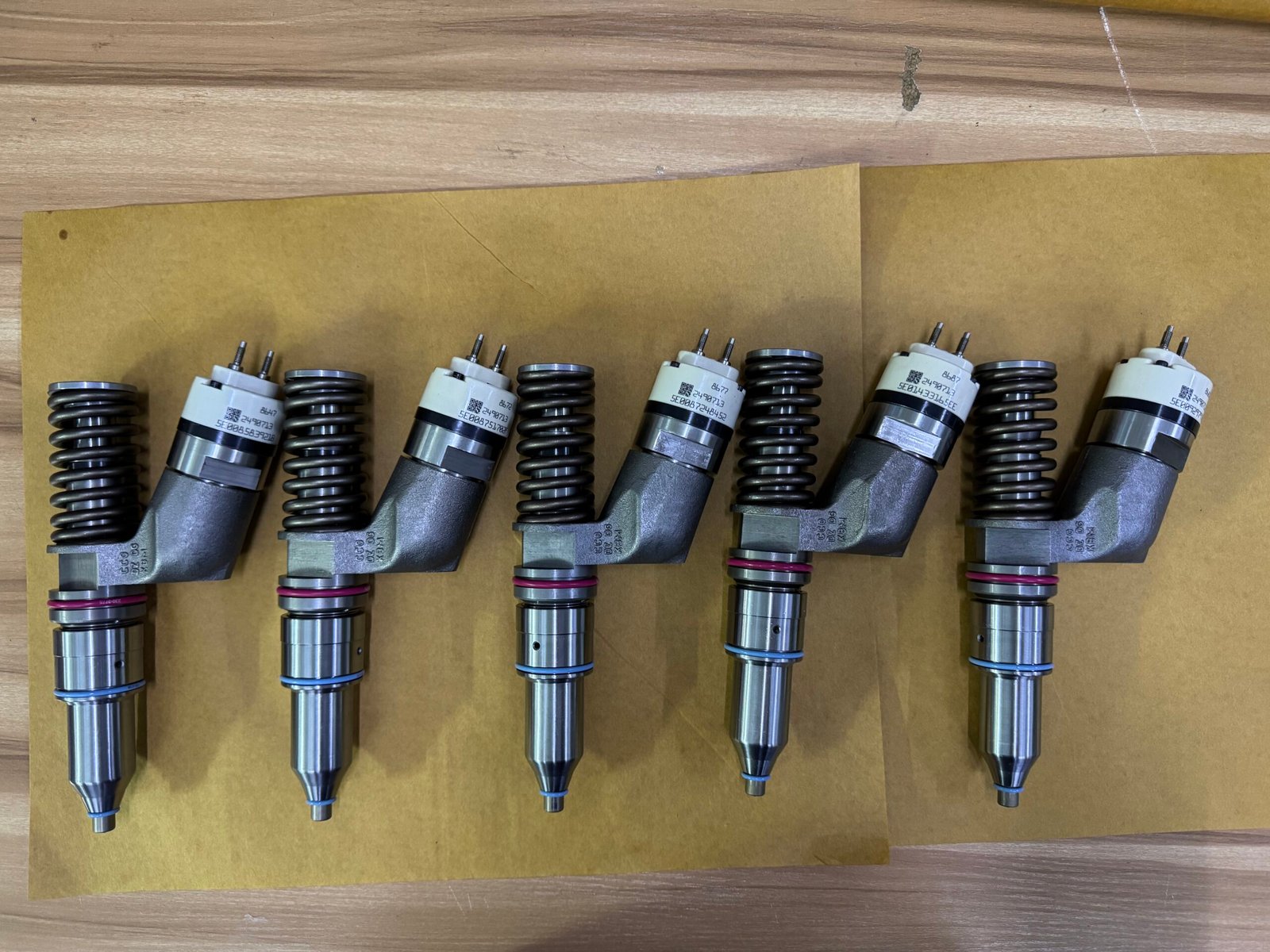
The 249-0713 injector test report below documents one bench test for a fuel injector cross-referenced as 249-0713 / 2490713 and 10R-3262 / 10R3262. These numbers are commonly used when identifying a replacement injector for Caterpillar C11 and C13 applications.
This is a reading of the supplied results file, not a generic claim about every injector carrying the same number. The tested unit is identified in the report as serial 8677, and every listed test step carries a pass mark.
What the 249-0713 injector test report identifies
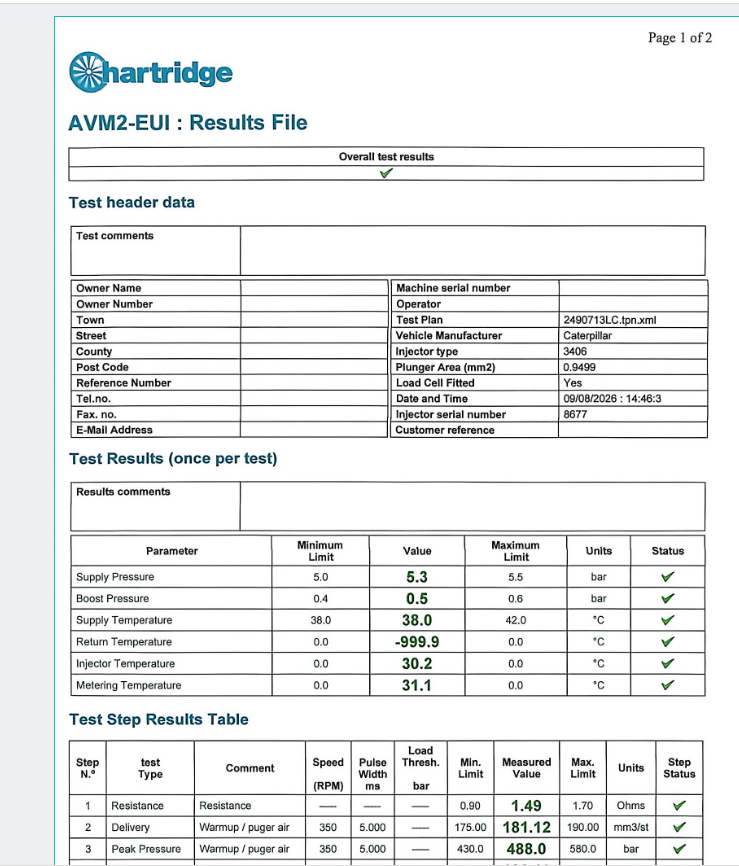
- Primary part number: 249-0713 (formatting variant: 2490713)
- Cross-reference: 10R-3262 (formatting variant: 10R3262)
- Application reference: Caterpillar C11 and C13
- Test system: Hartridge AVM2-EUI results file
- Configured test plan: 2490713LC.tpn.xml
- Report injector serial: 8677
- Overall result: Pass
The header also records 5.3 bar supply pressure, 0.5 bar boost pressure and 38.0°C supply temperature, all inside the limits shown in the report. Injector and metering temperatures were recorded at 30.2°C and 31.1°C. The exported return-temperature field displays -999.9°C; because that is not a physically meaningful operating temperature, it is not used in the interpretation below.
Key measured results
| Test point | Measured value | Allowed range | Status |
|---|---|---|---|
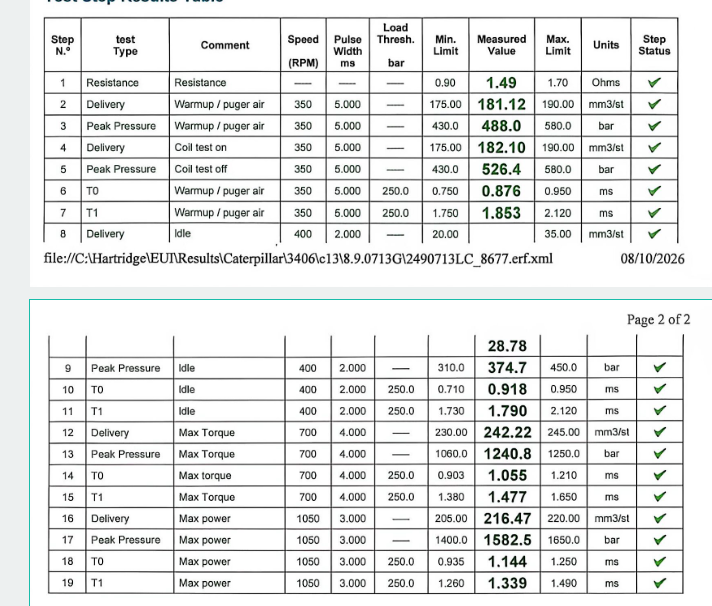
| Electrical resistance | 1.49 Ω | 0.90–1.70 Ω | Pass |
| Warm-up delivery | 181.12 mm³/st | 175.00–190.00 mm³/st | Pass |
| Warm-up peak pressure | 488.0 bar | 430.0–580.0 bar | Pass |
| Coil-test delivery | 182.10 mm³/st | 175.00–190.00 mm³/st | Pass |
| Coil-off peak pressure | 526.4 bar | 430.0–580.0 bar | Pass |
| Idle delivery | 28.78 mm³/st | 20.00–35.00 mm³/st | Pass |
| Idle peak pressure | 374.7 bar | 310.0–450.0 bar | Pass |
| Maximum-torque delivery | 242.22 mm³/st | 230.00–245.00 mm³/st | Pass |
| Maximum-torque peak pressure | 1240.8 bar | 1060.0–1250.0 bar | Pass |
| Maximum-power delivery | 216.47 mm³/st | 205.00–220.00 mm³/st | Pass |
| Maximum-power peak pressure | 1582.5 bar | 1400.0–1650.0 bar | Pass |
How to read the bench-test values
Resistance
The 1.49 Ω resistance value sits inside the test plan’s 0.90–1.70 Ω window. This is an electrical check of the actuator circuit under the configured procedure. It should be read together with the hydraulic results rather than used alone to judge an injector.
Delivery at different operating points
Fuel delivery was checked at warm-up, idle, maximum torque and maximum power. The measured values remained within their respective minimum and maximum limits. Testing across several operating points matters because an injector can behave differently at low delivery than it does under a heavier command.
Peak pressure
Peak pressure rose from 374.7 bar at the report’s idle point to 1240.8 bar at maximum torque and 1582.5 bar at maximum power. Each value remained inside the window configured by the test plan. These figures belong to the bench procedure and should not be treated as a direct substitute for on-engine rail-pressure or cylinder diagnostics.
T0 and T1 response timing
| Operating point | T0 measured / limit | T1 measured / limit | Status |
|---|---|---|---|
| Warm-up | 0.876 ms / 0.750–0.950 | 1.853 ms / 1.750–2.120 | Pass |
| Idle | 0.918 ms / 0.710–0.950 | 1.790 ms / 1.730–2.120 | Pass |
| Maximum torque | 1.055 ms / 0.903–1.210 | 1.477 ms / 1.380–1.650 | Pass |
| Maximum power | 1.144 ms / 0.935–1.250 | 1.339 ms / 1.260–1.490 | Pass |
T0 and T1 are response markers defined by the configured test routine. The important point in this report is not one isolated number, but that all four operating points fall inside the limits assigned by the test plan.
What the pass result means—and what it does not
For serial 8677, under the reported setup and test plan, the electrical, delivery, peak-pressure and response-time readings were within the displayed limits. That is the correct scope of the result.
A bench pass does not confirm vehicle fitment by itself, and it does not replace checks for wiring, fuel supply, engine compression, calibration, installation condition or other causes of an on-engine fault. It also should not be read as a blanket report for every unit in a batch. If a buyer needs a report tied to a particular supplied injector, that requirement should be confirmed before shipment.
Matching 249-0713 with 10R-3262
The hyphenated and non-hyphenated forms—249-0713/2490713 and 10R-3262/10R3262—are formatting variants used in searches and records. They should not be treated as four different parts. Before ordering, compare the number on the removed injector and confirm the Caterpillar engine or equipment details.
See the 249-0713 / 10R-3262 Caterpillar C11 C13 injector product page, browse Caterpillar diesel injection parts, or use the OE-number matching and quote form if the old label is unclear.
Before installation
- Confirm the exact OE number, engine model and old-injector markings.
- Inspect the fuel supply and wiring before replacing the injector.
- Use clean installation practices and the correct service procedure.
- Have a qualified diesel technician complete any required setup or calibration.
- Keep the unit-specific test record with the service paperwork when supplied.
For more background, visit the Rayfuel Diesel Parts Guide. Hartridge describes the AVM2-PC as a platform for detailed pump and injector assessment, including EUI applications; see the official AVM2-PC overview.
Caterpillar and Hartridge names and trademarks are used only for application and test-equipment identification. Rayfuel is not affiliated with or endorsed by those manufacturers.